
A six-second retargeting clip can show the model, the logo, and a full spin and never once show the hem, the lining, or how the fabric moves. That is the failure most apparel advertisers ship â a length problem wearing a creative problem's clothes.
So what is the right retargeting clothing ad length for someone who already opened the product page? Jason Gan's premise frames this entire article: retargeting is its own audience context, not a shorter cut of a cold ad. Warm viewers already know the brand, which makes intro seconds pure waste.
Three things must exist before a runtime means anything: a retargeting audience defined in your ad platform, garment photos with visible hems and even lighting, and one SKU you will test on. Digital Growth Tutor makes the same case for sizing cold, lookalike, and retargeting pools separately rather than as one pool. With that groundwork in place, one to six uploaded photos via turning product photos into video give every second a job to do.
One carve-out later breaks every rule above â structured garments earn far more seconds than basics, and the reason has nothing to do with budget.
How Long Should a Retargeting Video Ad for Clothing Be?
Six to ten seconds covers most clothing retargeting. Move to 11â20 seconds when one fit or fabric doubt is still open, and reserve 21â35 seconds for structured garments at higher price points.
Retargeting clothing ad length is the runtime you assign a warm-audience video, set by how many objections the viewer still holds rather than by what the platform permits.
- 6â10 seconds â a warm reminder. The viewer knows the product, so nothing new needs explaining and there is room for one fact: a restock, a new colorway, a price.
- 11â20 seconds â one open doubt. Enough for a single fit or fabric beat. Two beats in this window means neither lands.
- 21â35 seconds â structured garments at higher price points, where construction and movement carry the sale.
Think of a shop assistant at the register rather than on the floor. Someone who already tried the jacket on does not need the pitch again; they need the one unanswered thing, like the return window or the size still in stock.
Length is also capped by photography, not ambition. With one to six input photos, sharp garments, visible hems, and even lighting, you can only show the angles you actually captured â a 30-second plan resting on two flat lays produces padded runtime instead of new information. FashionUGC does not publish a per-account product or output limit, so plan runtime around your photo set.
How long should a retargeting video ad be when you only have two photos? Roughly 6â10 seconds. Each additional usable angle â a back view, a side profile, a fabric detail crop â buys another 4 to 6 seconds of runtime that carries information rather than filler. Two flat lays support a warm reminder and little else. A six-photo set with on-body shots and a fabric close-up can sustain 20 seconds, because every cut reveals something the viewer has not seen. Count your angles before you count your seconds.
Match Length to the Objection Your Shopper Still Has
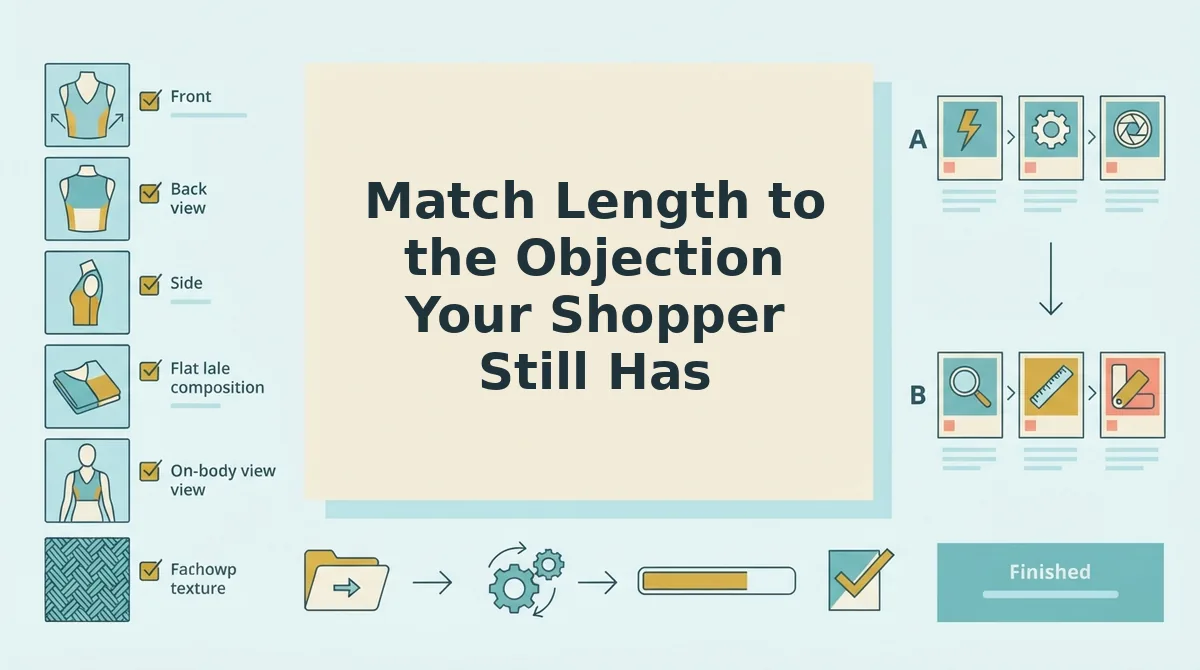
Length should follow the objection, not audience temperature. Cart abandoners need 6â10 seconds and a price or shipping nudge, product-page viewers need 11â20 seconds and one fit beat, and prior video viewers need 15â25 seconds that finally resolve fabric and movement.
| Audience | Objection still open | Closing beat | Runtime |
|---|---|---|---|
| Cart abandoner | Cost or delivery â the fit question is already settled | Price, shipping threshold, or returns line | 6â10 s |
| Product-page viewer, no add to cart | One unresolved fit or size doubt | Single fit beat: waist, sleeve, rise | 11â20 s |
| Prior video viewer | Fabric, drape, movement | Fabric in motion, close on the body | 15â25 s |
- Best for cart abandoners: a 6â10 second nudge that repeats the offer, not the product tour. Cart abandonment video ad length is a nudge problem, not a demonstration problem â the shopper cleared the fit question and stalled on cost or delivery.
- Best for product-page viewers: 11â20 seconds built around the one fit detail your reviews keep mentioning.
- Best for prior video viewers: 15â25 seconds of fabric in motion, using flat lay to fashion video to build the detail angles you never shot.
Repetition has genuine merit. The rule-of-7 argument â that people need repeated exposure before acting â holds well for basics and restocks, where a short clip seen four times beats a long clip seen once. For retargeting ads for clothing brands, the distinction matters: repetition of a six-second pan does not substitute for one second that shows how a shoulder sits.
That is the carve-out. Tailoring, denim, swim, and outerwear justify 20â35 seconds, because truncating them to six gives you a still image with a pan. Basics and restocks do not earn that runtime.
What matters next is what each second has to earn in a retargeting clip.
What Each Second Has to Earn in a Retargeting Clip
A retargeting clip is a budget of seconds, and every second has to buy a fact the viewer does not already have â a colorway, a restock, a hem detail, fabric movement, a price. Warm viewers have already met the brand, so an intro second is spent on an audience that skipped the intro.
That is the Second Budget: allocate runtime by what each second delivers, not by what feels like a finished ad. Build it in this order.
- Second 1 â the garment on a body, never the logo. Open on the item worn or held in motion, because recognition is already paid for and the first frame is the one the platform charges you for twice. If the shopper last saw a flat packshot, a body shot is the new information; placement-level scroll norms sit in Meta clothing video ad length.
- Seconds 2â4 â the one fact they are missing. Choose a single update: new colorway, restock, price change, extended size run. Two facts in a three-second window split attention and neither lands, so pick the one that answers the objection still open.
- Seconds 5â8 â one detail close-up. Land the hem, the stitch, the cuff, the lining, and land only one. A close-up is the cheapest proof a still photo cannot give, and stacking three of them turns proof into texture.
- Seconds 9â10 â the loop point. End on a frame that reads cleanly as an opening frame so the replay feels intentional, not truncated. This is where a 10-second cut earns its extra runtime over a 6.
- Serves 2 and 3 â loop math, not more runtime. Six seconds served three times is 18 seconds of exposure inside one impression slot: 6 Ã 3 = 18. That arithmetic, not a longer edit, is the mechanism behind Neil Patel's rule-of-7 repetition framing.
- The qualifier â repetition does not replace drape. Rule-of-7 logic assumes familiarity is the missing piece, and for apparel it often is not. If the open question is how a wool coat falls at the hip, three passes show the same six seconds three times; duration is the only thing that can show movement.
- Variants per SKU â one per usable angle, capped at six. The platform takes one to six images per item, so treat each angle as a candidate variant rather than packing every angle into one edit. One clip per strong angle keeps testing readable and gives each SKU a ladder instead of one all-purpose cut.
The workflow is upload-and-review: you supply the photo set, the generator assembles the seconds in this order, and a person approves the file before it runs anywhere.
How to Check Your Length Choice Worked
You need one structured SKU, its existing photo set, and ad account access to the cart-abandoner audience. Budget about 20 minutes to build and one full audience cycle to read the result.
- Pick one structured SKU (2 minutes). Choose the item with the most abandoned carts, not the bestseller. The test only reads cleanly when one variable moves at a time.
- Upload the same one to six photos twice and cut a 10-second and a 25-second version (10 minutes). Use the clothing video generator with an identical photo set for both. You should have two files that differ only in runtime.
- Open Ads Manager, then create one campaign with one ad set targeted at cart abandoners. Same placement, same budget, same landing page.
- Run the lengths sequentially, never at once (one cycle each). Running both simultaneously splits a small warm pool and starves both variants. Running back to back keeps the comparison readable.
- Compare which clip holds the objection that was still open, then roll the winning length to sibling SKUs that share construction. You should be able to name the objection the winner answered.
Answer the leftover questions the same way: cart abandoners and product-page viewers each get the clip that answers their own objection, so they usually differ, and one SKU needs two lengths at most until a winner is clear. The tool creates the video file and a person reviews it before it ships â the test measures your read on the objection, not a performance promise.
Start With One SKU, Not the Whole Catalog
Re-cutting a catalog feels like progress; resolving one item is progress. Take the SKU with the most abandoned carts, set its runtime from the objection it left behind, and build from photos you already own.
The whole method compresses to a line: loop math buys repetition, but only the seconds themselves can show how a garment moves, so keep the shortest cut that still delivers a new fact in second one and a detail by second five.
Sequence it objection first, runtime second, variant count third â inverting that order is what produces a library of 6-second clips nobody watches twice. Your next step: run that one SKU through the AI clothing ad generator, review the render yourself, and hold the second length until the first has an answer.