
Your best-performing clothing ad has gone quiet. Frequency is climbing, cost per purchase is drifting up, and the hero SKU still sells â just not through that creative anymore. Someone in the meeting suggests a shorter cut, or a longer one, based on a hunch. Before you book a second shoot, test clothing ad video length on the assets you already own: same garment, same photo set, several runtimes, one winner picked by cost per purchase. A fashion UGC video generator handles the rendering; the test design below decides what the output proves.
You need three things you already have: catalog or flat lay photos of a single garment, an ad account you control, and a fixed budget per variant. Fatigue on apparel creative is the practical trigger for this test â not curiosity about platform averages, which describe nobody's buyer in particular.
Below is the five-step protocol, the reason no category-wide "ideal length" applies to your SKU, and how to read the result without fooling yourself. One warning first: most length tests are invalidated by the one variable teams accidentally change, and it resurfaces at the locked-opening step.
How do I test different video lengths for a clothing ad?
Run one garment through a small ladder of runtimes using a single, unchanged photo set and identical opening frames, then judge each variant on hold rate, click-through rate and cost per purchase. Change runtime only. If the opening frames differ between versions, you are measuring hooks, not duration.
A Shopify seller holding flat lay and ghost mannequin photos of one dress needs runtime variants without booking a reshoot â one photo set covers every version. Gather 1â6 photos per garment (front, back, side, flat lay, fabric detail) in even lighting, with sharp plates and visible hems, plus an ad account you control and a fixed budget per variant.
- Upload the photos. Add your 1â6 images for the single garment. You should see each angle listed as a source before you generate anything.
- Lock the photo set. Note the exact filenames and reuse them for every runtime. The same photos across variants mean no reshoot per runtime.
- Generate the runtime ladder
Why is there no universal best length for fashion ads?
There is no universal best length for fashion ads because every published figure is a cross-category average, not a measurement of your SKU. A runtime that flatters a knotted midi dress says little about a heavyweight knit. An ideal-length benchmark is a per-platform average drawn from many advertisers' products â useful context, never a spec for one garment.
Choosing from it is like buying a dress because it fits most shoppers: the average is real, but it isn't your customer. Platform specs answer a different question entirely. A 9:16 vertical frame and a maximum duration decide whether the file delivers cleanly, not whether anyone watches past second three.
So what is the best length for a fashion ad?
The best length for a fashion ad is the runtime at which your own buyers on your own SKU hold, click and buy at the lowest cost â and only a controlled test on that SKU produces it. A cross-category average cannot tell you whether a stranger stayed past the hook, whether the hem detailing carried the click, or whether that attention was commercial. Those signals live in your account, not in a benchmark. Run one garment through a duration ladder and the answer becomes evidence about your buyer instead of a borrowed number.
Treat garment traits as hypotheses to fill that ladder, then confirm or discard each one in your own reporting:
- Texture â coarse knits may earn a longer hold than flat jersey.
- Hem and construction â ties and pleats need frames to register.
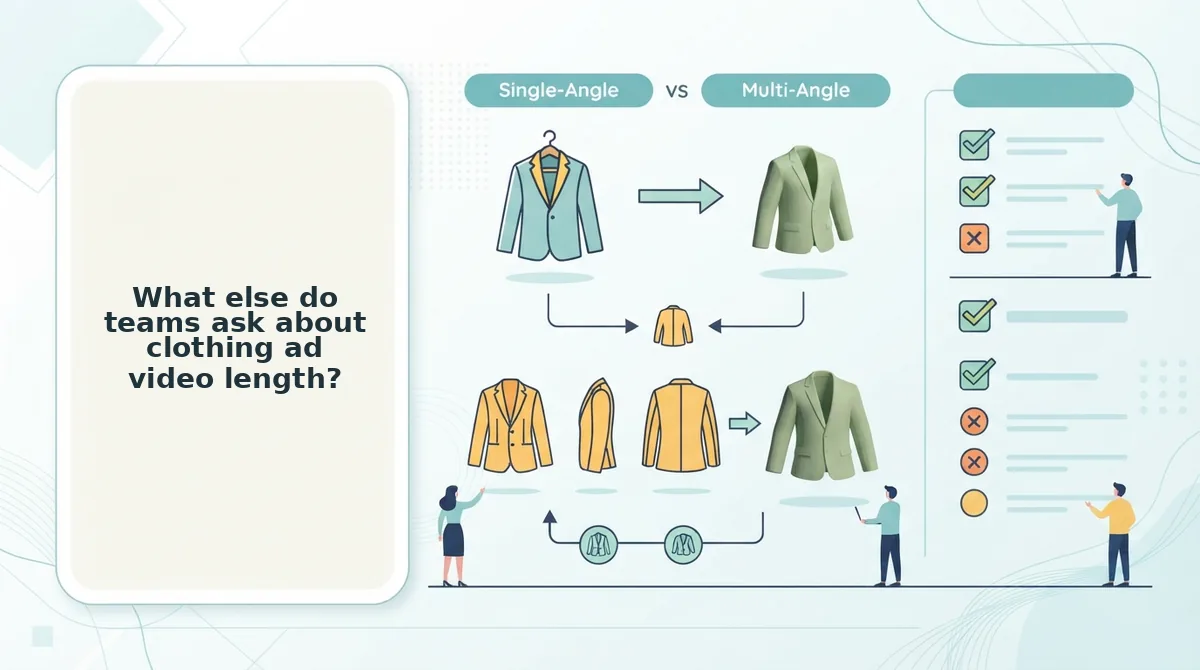
- Multi-angle fit â a back that reads differently may justify extra runtime.
- Simple basics â a plain tee has less to reveal; a short slot can carry it.
One rule holds throughout: change runtime only; keep the garment, the photos and the opening identical. FashionUGC's multi-version rendering for the same garment video exists for exactly that constraint.
Which runtime actually won is a readout question, not a rendering one.
How do you know which runtime actually won?
You know which runtime won by reading three signals under equal conditions: hold or watch-through, CTR, and cost per purchase. Judge them only after every variant ran on the same garment, the same audience, the same placement, and an equal budget. When the signals disagree, cost per purchase decides.
The launch conditions do the work. Same garment, same photo set, same locked opening, equal spend per variant. Change one of those and you have measured the change, not the runtime.
Reshoots and generic "ideal length" guidance are not useless â the first is the right call when the garment or styling itself changes, the second is a reasonable starting hypothesis. Neither isolates duration.
Runtime Spend Hold / watch-through CTR Cost per purchase Verdict Variant A â shortest â â â â â Variant B â mid â â â â â Variant C â longest â â â â â Copy those columns into a spreadsheet once and reuse them for every SKU; the sheet becomes the tool.
Each column asks a different question. Hold or watch-through shows whether the runtime held attention, CTR shows whether it earned the click, and cost per purchase shows whether that click was worth buying. Attention without clicks is a vanity win; clicks without purchases are an expensive one. When they conflict, CPA decides.
At review, a team sees the shortest cut leading hold rate, the longest leading CTR, and one mid-length variant leading cost per purchase. They keep the mid-length runtime for that SKU type â a decision, not a benchmark.
What else do teams ask about clothing ad video length?
How long should a TikTok clothing ad be?
Nine to twenty-one seconds is the working range for TikTok clothing ads, but duration should follow the garment rather than the feed. Knit texture, drape, or a multi-piece outfit needs time to read. A single tee does not. Hold the cut until the first product reveal lands.
Are short or long fashion video ads better?
Neither wins by default. Short runtimes suit high-recognition basics where one detail carries the sell. Longer runtimes suit garments whose value lives in movement, structure, or fabric behavior. Decide by how much the garment has to prove, and by whether your opening frames survive past the first reveal.
The rule underneath all four questions: change runtime, change nothing else.
How many runtimes should I test at once?
Three is the practical ladder: a short cut, a mid cut, and the longest version your opening can carry. Treat that count as judgment, not a sample-size rule. Adding more variants splits delivery across cells and muddies the readout you worked to isolate.
Do I need a reshoot for every runtime?
No. One to six photos of a single garment feed every runtime, so the length test runs off the catalog set you already own. Rendering a second cut costs an upload, not a studio day.
All of this gets simpler once the setup narrows to one garment and one photo set.
Start with one garment and one photo set
Pick the SKU you are already spending behind, upload the one to six photos you have on file, and hold the opening frames fixed while you render the ladder.
The entire loop fits into one working session:
- Name the SKU â one garment, one photo set, no substitutions mid-test.
- Size the ladder with the video length calculator before you render anything, so you build three runtimes instead of eight.
- Render every version in the clothing video generator from those same plates.
- Launch equal-budget variants and log hold rate, CTR, and cost per purchase, one row per runtime.
Then say the rule out loud to your team, word for word: change the runtime, change nothing else. Two variables at once and you are holding a hunch, not a readout.
The payoff the intro promised â a defensible runtime built from photos you already own â lands in that spreadsheet row, not in a second shoot.
A length test is only worth running when length is the only thing you changed.