
Your catalog has 400 SKUs, your creative team has two people, and your paid social performance is decaying every 72 hours. Static product photos can't keep up with the posting cadence TikTok and Reels demand, but choosing between Piveth vs Astra Engine for clothing video ads is a decision most brands make blind, comparing vague marketing copy instead of concrete output specs.
You're not wrong to feel stuck. Both engines promise to turn still apparel photography into motion, and both claim to solve creative fatigue. But they produce fundamentally different video files, different clip lengths, different framing, different motion intensity, and picking the wrong one means burning ad spend on creative that doesn't match your placement strategy.
This guide breaks down exactly what each engine generates, how their outputs differ across clip length, framing, and motion style, and which one fits your specific use case, whether that's rapid-fire testing or hero creative for product pages. You'll also see how an AI fashion UGC video generator handles multi-angle source ingestion to feed either workflow.
One finding in the comparison section will likely contradict what most creative teams assume about "longer video = better performance", and it changes how you should allocate production time across your catalog.
What Is the Piveth Engine?
The Piveth Engine is a video generation mode that converts static apparel photography into 10-second, fast-paced UGC-style clips built for high-frequency posting and rapid creative testing on TikTok, Instagram Reels, and YouTube Shorts.
Think of Piveth as a sprint interval workout for your product catalog. Where a full production shoot is a marathon, hours of setup, multiple takes, editing passes. Piveth takes the photos you already have and turns them into short, punchy motion sequences in minutes. The output is designed to be consumed quickly, scrolled past, and replaced just as fast.
How Piveth Works
You upload between one and six still photos of a single apparel item, front angle, back angle, side profile, flat lay, on-body shot, or fabric detail. The engine sequences these images into a 10-second clip with rapid cuts, subtle zoom and pan motion, and UGC-style pacing that mimics handheld creator content.
The motion style is deliberately fast-paced. Transitions between angles happen every one to two seconds, keeping the viewer's eye moving and matching the native cadence of short-form feeds. This isn't cinematic product storytelling, it's creative testing infrastructure.
Best Use Cases for Piveth
Piveth's 10-second format and quick-cut motion make it ideal for paid social testing at scale. When you're running creative tests against CAC across dozens of SKUs, you need volume, and Piveth delivers clips fast enough to test multiple angles per product without exhausting your production budget.
For brands managing large catalogs, Piveth solves a specific bottleneck: you can generate motion for an entire collection in a single afternoon, then push those clips into testing rotations. The short length also aligns with platform behavior. Reels and TikTok reward content that holds attention in the first three seconds, and Piveth's rapid angle changes are engineered for exactly that window.
If your workflow starts with turning clothing photos into video for testing purposes, Piveth is the engine you reach for first. It prioritizes quantity and iteration speed over cinematic polish, and for performance creative teams, that's usually the right tradeoff.
What Is the Astra Engine?
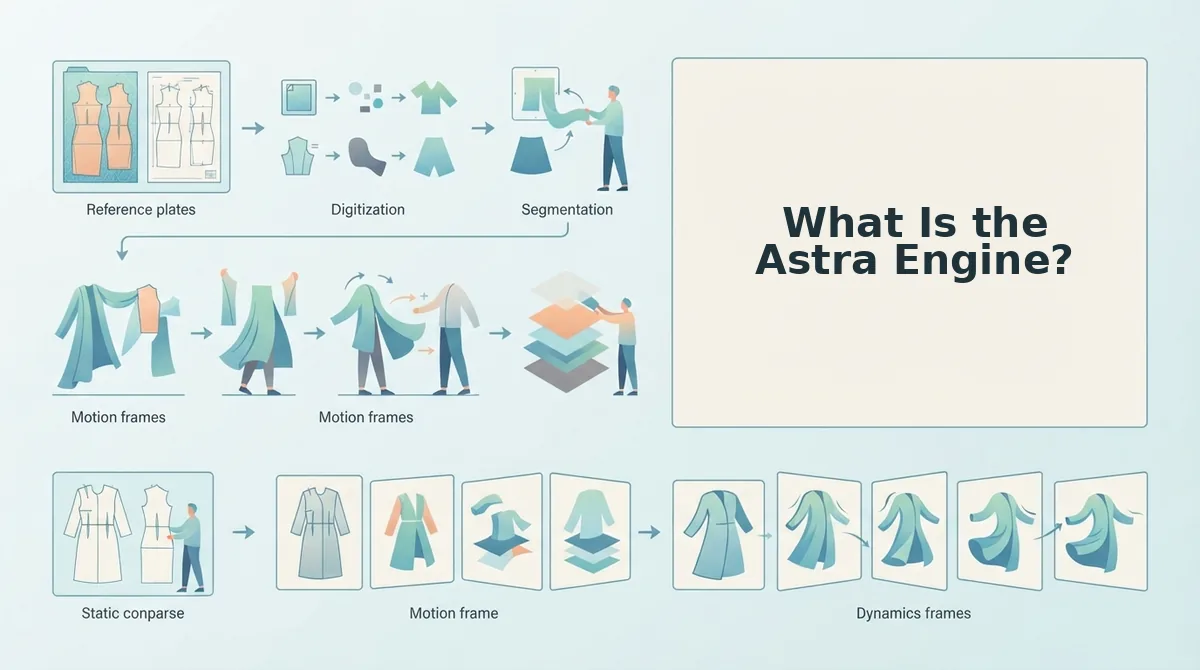
The Astra Engine is a video generation mode that produces extended motion sequences with wider framing and enhanced detail preservation, designed for hero creative, ecommerce product pages, and placements where viewers spend more time with a single asset.
If Piveth is a sprint interval, Astra is a slow pan across a gallery wall. The engine holds each angle longer, uses wider framing to show the garment in context, and preserves fabric texture and stitching detail that fast cuts would blur past. The result feels closer to a mini brand film than a testing asset.
How Astra Works
Astra ingests the same one-to-six source images as Piveth, front, back, side, flat lay, on-body, and detail shots, but sequences them with longer dwell time per angle and smoother, slower motion. Where Piveth cuts every one to two seconds, Astra lets each frame breathe, giving viewers time to register fit, drape, and construction quality.
The wider framing is the key technical difference. Astra pulls back to show the garment in fuller context, how a jacket sits on shoulders, how a dress falls at the hem, rather than cropping tight for mobile thumb-stopping impact. This framing choice matters because feed placements (Instagram feed, Facebook feed, YouTube) display video in landscape or square formats with more visual real estate, while Stories and Reels are vertical and favor tighter crops.
Best Use Cases for Astra
Astra is built for hero creative and product page video. When a shopper lands on your PDP and watches a 20-to-30-second clip, they're evaluating whether to buy, not scrolling past. Astra's extended sequences give them the detail they need: fabric texture, color accuracy, fit across multiple angles, and construction quality.
For feed placements, Astra's wider framing prevents the awkward cropping that happens when vertical-optimized clips get reformatted for square or landscape displays. A clothing video generator that offers both engines lets you match output to placement without re-shooting anything.
One more thing before the side-by-side: the assumption that longer Astra clips always outperform shorter Piveth clips in paid social is about to get tested.
Piveth vs Astra: Side-by-Side Comparison
Piveth and Astra are two distinct motion engines for converting static clothing photos into video ads. Piveth produces 10-second clips with standard framing and fast-paced UGC-style motion, while Astra generates extended motion sequences with wider framing and a cinematic feel. Your choice depends on campaign objective, placement, and how much detail your apparel needs to show.
| Attribute | Piveth Engine | Astra Engine |
|---|---|---|
| Clip length | 10 seconds | Extended motion sequences |
| Framing | Standard framing | Wider framing |
| Motion intensity | Fast-paced UGC style | Extended cinematic style |
| Best suited for | Paid social ads, TikTok, Reels, Stories | Product pages, high-consideration apparel, catalog detail views |
| Creative fatigue strategy | High-volume iteration for testing | Longer dwell time per asset |
Piveth's strength is speed and volume. A 10-second clip with standard framing matches the native format of TikTok and Instagram Reels, where viewers scroll quickly and creative fatigue sets in within days. Teams running performance creative against CAC benefit from producing many short variations cheaply and testing them in parallel.
Astra's strength is dwell time and detail. Wider framing and extended motion let a viewer see how fabric drapes, how a garment fits across the shoulders, and how construction details hold up in movement. This matters for apparel priced above impulse-buy territory, where a purchase decision requires more than a three-second hook.
Best for performance creative teams running paid social: Piveth. You need volume, speed, and native-format clips that match TikTok and Reels consumption patterns.
Best for ecommerce merchandisers optimizing product pages: Astra. You need extended viewing time and wider framing that shows fit and fabric detail before a shopper adds to cart.
Neither engine is objectively superior. Piveth wins on iteration velocity; Astra wins on information density per clip. Many apparel brands run both: Piveth for top-of-funnel prospecting and Astra for retargeting and product page embeds.
When Clip Length Changes the Purchase Decision
A 10-second Piveth clip shows a garment in motion long enough to stop a scroll but not long enough to answer fit questions. An extended Astra sequence gives a shopper time to observe how a dress moves while walking, whether a jacket pulls at the buttons, and how a knit drapes over the hips. For apparel priced above $80, these details directly reduce return rates and increase conversion confidence. The tradeoff is production volume: you can generate more Piveth clips per hour, but each Astra clip carries more persuasive weight per view.
How to Choose: A Decision Matrix for Apparel Marketers
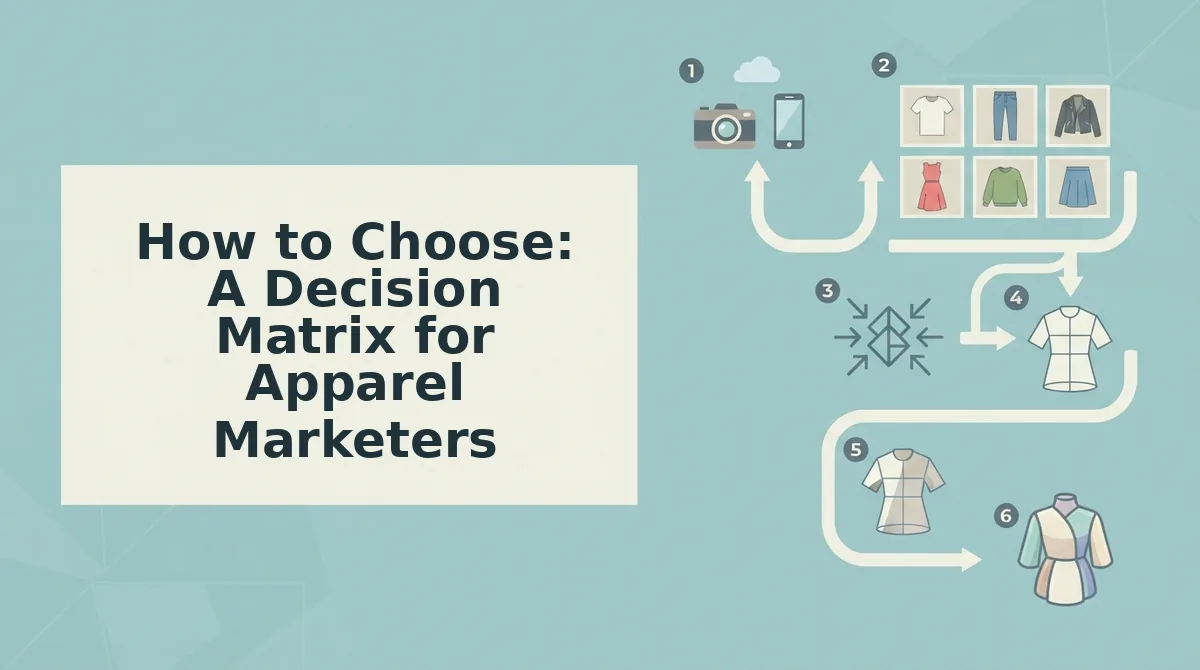
Choosing between Piveth and Astra comes down to four variables: campaign objective, placement, apparel price point, and creative fatigue tolerance. Work through the steps below in order. You need your campaign objective defined, your placement list, and your average order value before starting.
- Define your campaign objective. Write down whether this asset serves awareness, retargeting, conversion, or catalog display.
- Awareness: Select Piveth. Fast-paced 10-second clips match the scroll velocity of cold audiences.
- Retargeting: Select Astra. Shoppers who already visited your product page need detail time, not another hook.
- Conversion: Select Piveth for paid social, Astra for product page embeds.
- Catalog: Select Astra. Wider framing and extended motion show fit and construction that catalog stills cannot.
You should see a clear engine match for each objective before moving on.
- List every placement where the video will run. Open your media plan and note each channel.
- TikTok, Reels, Stories: Piveth. These placements reward native-format, fast-paced clips.
- Feed ads (Facebook, Instagram): Either engine works, but Piveth's 10-second length aligns with feed attention spans.
- Product page video: Astra. Shoppers on a product page are already interested; give them detail.
You should have an engine assigned to each placement row.
- Check your average order value. Pull your store's AOV from Shopify or your analytics dashboard.
- Under $50: Piveth. Impulse purchases need volume and speed, not extended detail.
- $50 - $120: Mix both. Use Piveth for prospecting and Astra for retargeting.
- Over $120: Astra. High-consideration apparel needs fabric drape, fit, and construction time on screen.
You should have a price-based recommendation that either confirms or overrides your objective match.
- Assess your creative fatigue cycle. Check how often your current ad sets decay in performance.
- Fatigue in under 5 days: Piveth. You need high-volume iteration to keep fresh creative in rotation.
- Fatigue in 1-2 weeks: Either engine. Match to objective and placement instead.
- Fatigue beyond 2 weeks: Astra. Longer clips with more detail sustain engagement without constant replacement.
You should now have a final engine recommendation per campaign.
If your matrix points to Piveth for TikTok placements, pair it with a workflow built for TikTok fashion video ads that turns existing product photos into native-format motion in minutes. The decision matrix above removes guesswork: match the engine to the objective, placement, price point, and fatigue cycle, and you will generate the right asset type on the first pass.
The Contrarian Case: When Longer Astra Clips Outperform Piveth
Astra is the motion engine that generates extended cinematic sequences with wider framing from static apparel photography. The default assumption in performance creative is that shorter always wins, but that assumption breaks down for high-consideration apparel where shoppers need time to evaluate fit, fabric, and construction before committing to a purchase.
Think of a Piveth clip like a movie trailer: it builds excitement in 10 seconds but leaves out the details. An Astra clip is more like a scene from the film itself. You see how the fabric moves, how the garment sits on a body in motion, and whether the construction holds up under real movement. Trailers drive ticket sales, but scenes drive conviction.
High-consideration apparel demands detail time. A shopper evaluating a $140 merino sweater wants to see how the knit drapes over the shoulders, whether the cuffs hold their shape, and how the hem falls when the model turns. A 10-second Piveth clip cannot show all of that. An extended Astra sequence can, and that detail time directly reduces the uncertainty that causes cart abandonment and post-purchase returns.
Product page video is where Astra's wider framing and extended motion create the most measurable lift. A shopper who lands on a product page has already expressed interest. The job of video at that moment is not to stop a scroll; it is to answer the remaining questions that stand between browsing and buying. Wider framing shows the full garment in context, and extended motion lets the shopper observe how it behaves over time rather than in a single frozen moment.
Why Detail Time Converts for High-Consideration Apparel
High-consideration apparel purchases involve fabric drape, fit across multiple body angles, and construction details like seam quality and button placement. A 10-second clip shows a garment exists; an extended Astra sequence shows whether it will work for the shopper's body and expectations. For product listing videos on ecommerce pages, this extended viewing time translates into higher add-to-cart confidence and fewer returns. The counterintuitive result is that longer clips can outperform shorter ones when the purchase decision requires evaluation rather than impulse. For a deeper look at how extended motion performs in catalog contexts, see product listing videos.
If your apparel sits above impulse-buy pricing, test Astra on your product pages before defaulting to Piveth everywhere. The results may challenge your assumptions about what length actually converts.
Piveth vs Astra Engine: Frequently Asked Questions
Piveth and Astra are two motion engines inside the FashionUGC platform that convert static apparel photos into UGC-style video. Piveth prioritizes fast, short, high-volume clips for paid social iteration; Astra prioritizes longer, detail-rich clips with slower pacing for product pages and retargeting.
What is the difference between Piveth and Astra motion engines for clothing video ads?
Piveth generates 6-12 second clips optimized for rapid hook testing and volume creative iteration. Astra generates 15-30 second clips with slower camera moves, fabric detail emphasis, and multi-angle sequencing. Piveth favors speed and quantity; Astra favors depth, texture, and storytelling.
Which engine is better for TikTok ads?
Piveth is better for TikTok ads because its 6-12 second output matches TikTok's fast-scroll behavior and supports rapid creative testing against CAC. Astra clips can work on TikTok as retargeting or mid-funnel creative, but Piveth's pacing aligns more closely with cold-audience discovery feeds.
Can I use both engines in the same campaign?
Yes. Run Piveth clips as cold-audience prospecting creative and Astra clips as retargeting or product-page video. The two engines produce different pacing and detail levels, so combining them covers both the hook-driven top of funnel and the detail-driven bottom of funnel without duplicating creative.
How does framing width affect ad performance?
Framing width changes how much of the garment and surrounding context appears in each shot. Tight framing on fabric details and stitching works well for quality-focused audiences; wider framing that shows the full garment on-body or in motion works better for style discovery and cold traffic. Piveth defaults to tighter, faster cuts; Astra uses wider, slower compositions.
Is Piveth or Astra better for product page video?
Astra is better for product page video because its longer runtime and slower pacing let shoppers inspect fabric texture, fit, and construction details before adding to cart. Piveth clips are too short for product-page education and work best as paid social hooks that drive traffic to the page.
If you are deciding between the two engines, start with Piveth for paid social volume and add Astra for product pages and retargeting. Piveth produces more iterations per hour, which matters when you are testing hooks against CAC. Astra produces fewer, richer clips that hold attention on a product detail page. Most apparel brands run both engines simultaneously: Piveth feeds the top of funnel with fast hooks, Astra closes the loop with detail-rich video where purchase intent is highest.
Piveth or Astra: Your Next Step
The choice between Piveth and Astra is not a permanent commitment, it is a workflow decision you can change per SKU, per campaign, and per funnel stage. The brands that get the most from FashionUGC treat the two engines as complementary tools, not competing options.
Choose Piveth when you need volume, iteration speed, and cold-audience hooks. Choose Astra when you need depth, detail, and conversion-focused product storytelling. Most apparel teams run Piveth for prospecting and Astra for retargeting and product pages, which is exactly how the engines were designed to work together.
Your next step is to upload one product's existing photos, front, back, detail, and flat lay, into the AI fashion UGC video generator and generate one Piveth clip and one Astra clip from the same source images. Compare pacing, framing, and detail emphasis side by side. That single comparison will tell you more about which engine fits your brand than any article can.
You already own the photography. The motion is one upload away.