

Eight to twelve seconds is the working default for a marketplace clothing video, and 15 seconds is the ceiling most listings allow. The harder question is why the vertical clip you shot keeps losing the hem the moment it lands in a square gallery slot.
You already know the pressure. Secondhand and resale listings are dense â CBC News coverage of clothing waste has made the sheer volume of circulating apparel hard to ignore â so a static packshot is competing against a scroll of near-identical stills. Motion is how a clothing video for marketplace listing buys a second of attention.
This guide gives you the plain duration answer, a cap table spanning Etsy, Amazon, an owned Shopify PDP, paid placements, and retargeting, then a three-beat structure with hard timecodes you can build inside whichever cap applies. It also resolves the cropping problem above â and the fix is not shooting shorter. It is composing for the strictest aspect ratio in your publishing set, which changes how you frame the very first frame.
Start with the photos you already own. Turn product photos into video from one to six angles â front, back, side, flat lay, on-body, fabric detail â without booking a reshoot.
How long should a clothing video be for a marketplace listing
For a marketplace listing, target 8 to 12 seconds and never exceed the platform's cap â typically up to 15 seconds on Etsy and longer on some Amazon placements. An owned product page or a paid placement has no platform ceiling, so there the duration decision belongs to you.
That split is the entire comparison. A gallery slot is rented space with published specs; your own product page and your ad account are owned space, where length answers to clarity and to creative volume. Marshall Crews' brand-side argument holds here: paid placements tolerate longer cuts because a brand can ship many variants and retire the weak ones, while a single listing gets one slot and one shot at the crop.
| Placement | Typical duration band | Who sets the limit | Best for |
|---|---|---|---|
| Etsy listing video | Up to ~15s (estimate) | Platform cap â confirm on Etsy's help page | Resellers and vintage sellers listing a handful of hero pieces per drop |
| Amazon product video | Longer than gallery slots, ~30s on some placements (estimate) | Platform cap â confirm in Seller Central | Registered brands running A+ content across a catalog |
| Owned Shopify PDP | 8â15s, muted autoplay | You | DTC brands controlling their own merchandising and page order |
| Paid social placement | 10â20s | You, and the feed's patience | Performance creative teams testing hooks against CAC |
| Retargeting | 6â10s | You | Warm audiences who already saw the packshot once |
Treat every platform number as a band, not a spec. Etsy and Amazon both revise listing requirements without much notice, and a duration that uploaded cleanly last quarter can fail a format check this one. Before you export, open the platform's own help page, find the current maximum for listing video, and set your timeline against that number rather than against a blog post â including this one. The cap you cannot verify is the cap that costs you a re-render.
Once the cap is fixed, the creative question is what fills it. Fashion UGC video examples show the usable range: a single garment, one camera idea, no voiceover, and a clean loop. Generating a draft from your existing catalog photos is the fastest way to see whether your chosen length actually holds the garment.
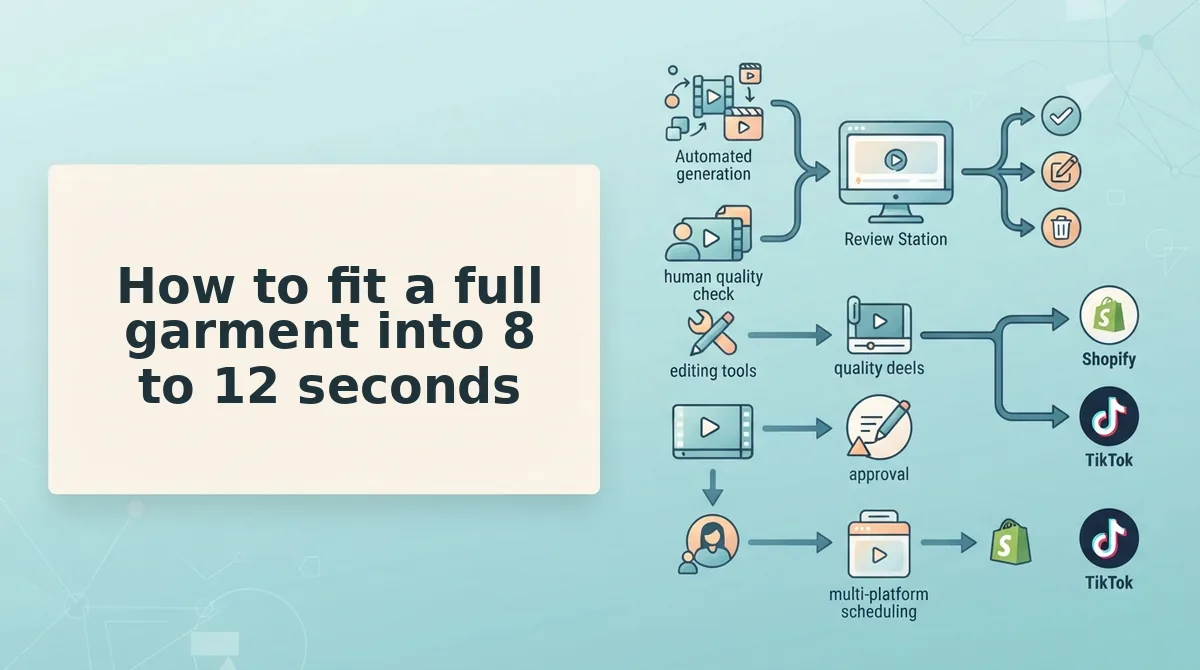
How to fit a full garment into 8 to 12 seconds
Build the clip as three beats: reveal at 0â2 seconds, drape and fit at 2â8, detail at 8â14. That structure fits inside every cap in the table above and delivers the three things a still cannot â silhouette, movement, and texture â without asking the viewer to wait for a payoff.
- 0â2s, reveal. Open on the garment already worn or already hanging. No logo card, no text-only frame; the first frame is the thumbnail on half these surfaces.
- 2â8s, drape and fit. One movement that shows how the fabric falls â a turn, a walk toward camera, a hand lifting the shoulder seam. This is where fit is communicated.
- 8â14s, detail. Cut to a single close-up: stitching, print, cuff, or drape at the hem. One detail, held long enough to read.
How many details fit in 15 seconds? Roughly one per three seconds â an estimate and a craft judgment, not a measured result. In practice that means four or five details is the realistic maximum before a clip becomes a slideshow with music over it.
Then apply the crop-safety rule: compose for the strictest aspect ratio in your publishing set, not the widest. If a square gallery slot and a vertical Reel both need this clip, frame for the square and let the vertical crop the sides. Our guide to fashion video aspect ratios covers the safe zones per surface. That is the answer to the cropping problem from the top of this page â you do not shoot shorter, you frame tighter, so a square slot never slices the hem off a vertical clip.
The approach Nikki Davidson's Photo Hacks material describes is the practical version: a seller listing clothes from photos they already own cuts an 8-second single-motion clip from two stills instead of forcing a 20-second narrative the source images cannot support. Duration follows reference material.
Your next step is one upload: bring one to six angles of a single garment, generate a draft inside your marketplace cap, and review it before it goes anywhere near a listing. The photos sitting in your catalog already contain the clip â the only thing left to decide is how many seconds of it the marketplace will let you keep.