
Twelve SKUs are staged in a folder, the render queue is empty, and one field has to be filled in before anything moves: the runtime. Ten seconds or thirty? The 10 second vs 30 second clothing ad question feels like a taste call, and most teams settle it by copying whatever the last campaign used. Clothing ad length is not a taste call. It is a count of how many separate claims about a garment the video has to land.
That framing matters more here than on most platforms. In a fashion UGC generator workflow, the tool outputs the video file and a person reviews it before it goes anywhere, so runtime is a decision you make at render time rather than a default you inherit from a placement.
Here is the rule this page unpacks, plus a coverage matrix you can hold against photos you already own: ten seconds proves one thing about a garment, thirty seconds proves four. You will see which garment attributes each runtime can actually carry, how your existing plate count constrains the answer, and why the longer cut is usually not the paid-social asset at all.
Ten Seconds Proves One Claim and Thirty Seconds Proves Four
Ten seconds proves one thing about a garment; thirty seconds proves four. Pick the runtime by counting the claims the placement needs, not by how long a finished spot feels â a short cut that lands silhouette and colorway beats a long cut that repeats them.
Four terms carry the comparison. Runtime is the finished duration in seconds. Hook is the opening beat that stops a scroll. Coverage is the number of distinct garment attributes the cut actually shows. A UGC-style cut is edited like a creator's single take rather than a compressed broadcast commercial.
| Garment attribute | 10-second cut | 30-second cut |
|---|---|---|
| Silhouette | Covered | Covered |
| Drape in motion | Partial â one beat | Covered â multiple beats |
| Fit on body | Partial â one frame | Covered |
| Fabric texture | Partial | Covered |
| Construction detail (hem, seam, closure) | Not covered | Covered |
| Colorway | Covered | Covered |
The matrix describes coverage, not performance. It is not a test result and makes no claim about how either cut converts. Because the generator draws coverage from the plates you upload, one to six angles per item raises what any runtime can show.
The 30-second format earns its length honestly in brand-seasonal films and retailer TV, where one spot carries story, styling and mood alongside product.
Best for the performance creative team: 10 seconds, shipped as several variants per SKU against a fixed budget. Best for the merchandiser owning a product detail page: 30 seconds, where the viewer has already clicked and wants construction and fit.
How long should a clothing ad be? Long enough to show every claim the garment is sold on, and no longer. A basic tee with one selling point â the cut â works at ten seconds. A structured jacket sold on a shoulder seam, a two-way closure and a lined interior needs thirty to show all three without repeating coverage. Count the claims first, then choose the runtime, then check that your photo set holds the angles to support them.
What a 10-Second Cut Can and Cannot Show
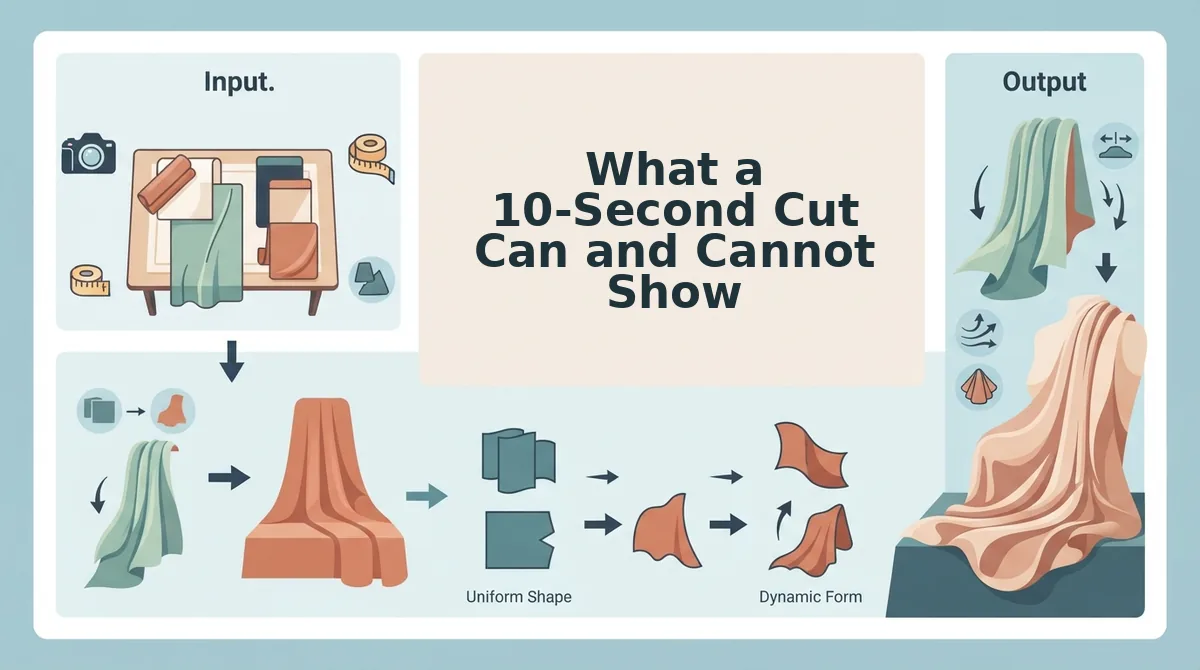
Ten seconds covers four garment attributes and nothing more: silhouette, one drape beat in motion, colorway, and a single hero angle in 9:16. Anything past that â a hem, a seam, a closure, fit across body types â needs time the short cut does not have.
- Silhouette. One clean outline tells a viewer whether the piece is boxy, bias-cut or cropped. Open on the front plate and hold long enough for the shape to register before motion starts.
- One drape beat in motion. A single turn or walk-on shows how the fabric falls. Give it the middle of the run and cut before a second movement dilutes it.
- Colorway. Ten seconds holds one color read cleanly. Use the plate shot under neutral light so the shade matches the product page.
- One hero angle in 9:16. Vertical framing is the whole asset. Choose the angle that best sells the garment and let it own the frame.
- Construction detail at scroll speed. A topstitched hem or hidden placket needs a held frame; viewers see texture, not stitch count.
- Fit evidence across body types. One frame reads as one body. Fit claims belong to a longer cut or a size guide.
- Back or interior views. There is no room for a second camera position without eating the claim.
- A second claim without feeling rushed. Two claims in ten seconds means neither lands.
Run the test in under a minute: if the garment's selling point is a hem, seam or closure, ten seconds is the wrong unit for that claim. Treat the short cut as one creator beat, not a compressed commercial, and check it against Instagram Reels placements before you queue it. The thirty-second cut is a different animal.
What a 30-Second Cut Can and Cannot Show
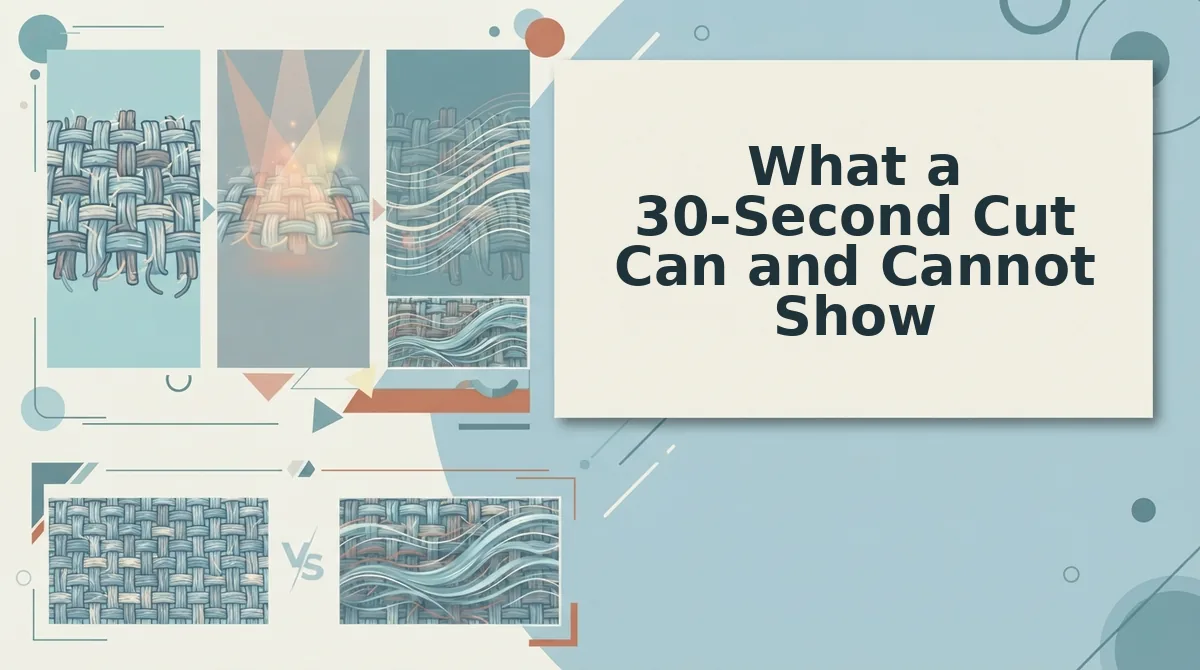
A 30-second clothing ad is a four-beat sequence in which each beat has to prove a separate thing about the garment. That distinction matters more than the number itself: thirty seconds does not buy more time with the same two shots, it buys room for claims the short cut has to drop.
Think of the difference the way a tailor's fitting works next to a glance in a shop mirror. The glance confirms the silhouette; the fitting is where hem, shoulder seam, closure and fabric under light all get checked â but only if the tailor walks you through each one.
What the extra seconds buy
At the simple end, thirty seconds fits fit-on-body evidence the ten-second cut cannot: a full turn, a walking beat, a sleeve or leg in motion. One level deeper, it accommodates construction detail â hem finish, seam placement, a zip, a button placket â each needing its own readable frame.
At the advanced end it buys fabric texture at close range and a second and third angle, which is what stops a thirty-second edit from feeling like a stretched still. A five- or six-plate set supports four distinct beats without a repeat.
What the extra seconds cost
Two things go. Hook density â how much new visual information the first two seconds carry â drops, because the opening beat competes with feeds that reward the fastest reveal. And tolerance for repeated coverage collapses: the same plate used twice reads as padding at thirty seconds and as emphasis at ten.
So the long runtime only pays off once the viewer has opted in to watch â a product page, a brand channel. At that point short form vs long form stops being an attention argument and becomes a question of how many distinct views the photo set actually holds.
Match the Runtime to the Placement, Not to Preference
Pick the runtime by where the video will run, then confirm the photo set can fill it. Placement decides how many garment claims the viewer has already agreed to receive.
Paid feed, Reels, TikTok and retargeting all take the 10-second cut: the feed rewards one fast claim, and a retargeted viewer already knows the item. The PDP gallery and the seasonal brand film take the 30-second cut, where the runtime does detail and mood work rather than SKU-level reach.
The counterintuitive half â thirty seconds belongs on the product page, not in the feed â rests on one observed set: the highest-viewed 30-second apparel spot there was a retailer seasonal film (M&S The New Autumn Season A/W16, 538,013 views), while SKU-level 30-second spots ran at 183 views (Tennis Express) and 1,356 (New York Men's Clothing). Treat that as an observed pattern, not a law.
How long should a clothing ad be?
Length should equal claim count. A clothing ad runs 10 seconds when it makes one claim, usually silhouette or drape in motion, and 30 seconds when it must prove fit on body, construction detail and fabric texture in sequence. The check is whether the photo set holds enough distinct angles to fill each beat; if it does not, the extra twenty seconds repeat coverage already seen, which reads as padding rather than proof. Runtime is a coverage decision before it is an attention decision.
That closes the loop: the two runtimes are not rivals but two slots in one catalog. Validate the map against your own placement data before adopting it.
Start with one SKU and the plates you already own â product listing videos built from those photos give you both cuts to compare, and a person reviews each file before it goes anywhere.
One garment proved is the whole method: the catalog follows.