

You've watched a 9-second clothing ad flop while a 31-second version of the same garment outperforms it, and you're left wondering if the rules you learned about short-form video even apply to apparel. The question of how long should clothing video ads be on TikTok has a frustratingly conditional answer, and most generic advice ignores what makes fashion creative fundamentally different from other product categories.
You're right to be skeptical of blanket "keep it under 15 seconds" guidance. TikTok's official recommendation of 21-34 seconds exists for a reason, yet countless fashion brands still default to ultra-short cuts that never give viewers time to register a silhouette, check a hemline, or assess how fabric drapes in motion. This article breaks down exactly what TikTok recommends, why apparel demands a longer viewing window than most categories, and how to structure duration around your specific ad objective, whether that's cold-traffic awareness or bottom-funnel retargeting.
Along the way, you'll learn how a clothing video generator can turn your existing product photography into motion-ready creative that respects these timing constraints, and one counterintuitive finding about the 3-second garment rule that may change how you brief every future edit.
What TikTok Officially Recommends for Ad Length
TikTok's official guidance for in-feed advertising recommends video lengths between 21 and 34 seconds for optimal engagement and completion rates. This range reflects the platform's own data on when viewers remain attentive enough to absorb a message without dropping off.
Think of TikTok ad duration like a fitting room mirror: too little time and the customer never sees how the garment actually sits on a body; too much time and they've already mentally moved on to the next rack. The 21-34 second window is the platform's equivalent of giving a shopper just enough mirror time to make a decision without losing interest.
But here's where the general recommendation collides with apparel reality. A 21-second ad for a skincare product can show the product, demonstrate application, and deliver a testimonial cleanly. A 21-second ad for a structured blazer, however, must also communicate garment motion (how the fabric moves when worn), fit demonstration (how it sits on different body types), and SKU detail requirements (stitching, hardware, lining, closure type). That's three additional information layers most product categories never need to convey.
This gap between TikTok's baseline guidance and what clothing actually requires is why apparel brands need a category-specific framework rather than a one-size-fits-all duration rule. The 3-second garment rule, covered next, explains why.
The 3-Second Garment Rule: Why Clothing Ads Need More Time
The 3-second garment rule is a creative framework stating that viewers need a minimum of three continuous seconds to register a garment's silhouette, color, and fit before any persuasive messaging can land. Without that baseline window, the brain processes the video as abstract motion rather than as a product presentation.
Think of it like walking past a storefront window: if you're moving at full speed, you register only a blur of color. Slow to a three-second glance, and suddenly you've noted the cut of the jacket, the drape of the trousers, whether the neckline flatters. That three-second glance is the minimum cognitive threshold for garment comprehension, and it's non-negotiable in video form.
This is precisely why ultra-short 5-7 second ads fail for apparel even when they perform well for categories like beverages, snacks, or tech accessories. A 6-second ad showing a phone case works because the product is visually static and instantly recognizable. A 6-second ad showing a midi dress forces the viewer to process fabric weight, hem length, waist definition, and movement, all within the same window where a phone case ad has already finished its pitch. The result is a viewer who saw something but couldn't tell you what the garment actually looked like.
For DTC apparel operators, the practical implication is clear: if your edit doesn't hold a single garment view for at least three uninterrupted seconds, no amount of hook optimization will save the creative. Duration decisions must start from this floor, then scale upward based on what the ad needs to accomplish.
That scaling logic is exactly what the next section addresses.
Duration by Ad Objective: The Decision Matrix
Ad duration is not one-size-fits-all; the right length depends on what you want the viewer to do and what visual assets you have available. TikTok's own creative guidance and performance data from fashion advertisers consistently show that awareness, conversion, retargeting, and launch objectives each have distinct duration sweet spots.
The matrix below maps ad objective against asset depth to give you a decision framework rather than a single number. Single flat lays work for quick-hit awareness, while multi-angle packshots justify longer storytelling for conversion and launch campaigns.
| Ad Objective | Single Flat Lay / 1-2 Photos | Multi-Angle Packshot / 3-6 Photos | Best For |
|---|---|---|---|
| Awareness | 10-15 seconds | 10-15 seconds | DTC brands launching a new collection to cold audiences who have never seen the garment |
| Conversion | 15-20 seconds | 21-25 seconds | Shopify merchants running catalog campaigns where the product page is the destination |
| Retargeting | 10-15 seconds | 10-15 seconds | Performance creative teams re-engaging users who viewed a product but did not purchase |
| Product Launch | 20-25 seconds | 25-30 seconds | Boutique operators introducing a hero piece that needs fabric, fit, and detail storytelling |
Conversion ads at 21-25 seconds outperform shorter variants when the viewer needs to see fit, drape, and fabric movement before clicking through. Retargeting ads can stay at 10-15 seconds because the viewer already has context from the first touchpoint.
If you are working from flat lays only, a clothing video generator can add motion and UGC-style framing to extend a single image into a viable 15-second awareness spot without additional photography.
Duration by Asset Count: How Many Photos You Have Changes the Answer
Asset depth is the number of distinct source photos you have for a single garment, and it directly determines how long your ad can sustain viewer attention. Think of it like a film editor's raw footage: you cannot cut a 30-second scene from 10 seconds of material without repeating shots and boring the audience.
1-2 photos: Keep the ad under 15 seconds. With only a front shot and a flat lay, you have roughly two visual beats. A product photo to video workflow can add motion, zoom, and text overlays to stretch this to 12-15 seconds, but beyond that the repetition becomes obvious.
3-4 photos: This is the 15-21 second zone. Front, back, and one detail or on-body shot give you enough variety for a hook, a mid-ad garment reveal, and a closing CTA without visual fatigue.
5-6 photos: You can sustain 21-30 seconds for a full garment story. Multi-angle packshots, fabric close-ups, and on-body shots let you sequence fit, texture, and styling context the way a short-form fashion edit would.
If your catalog only has one or two images per SKU, the platform's multi-angle ingestion accepts up to six stills, so you can build asset depth from existing photography before generating longer conversion or launch ads.
The Ad Fatigue Rotation: Why You Need Multiple Durations
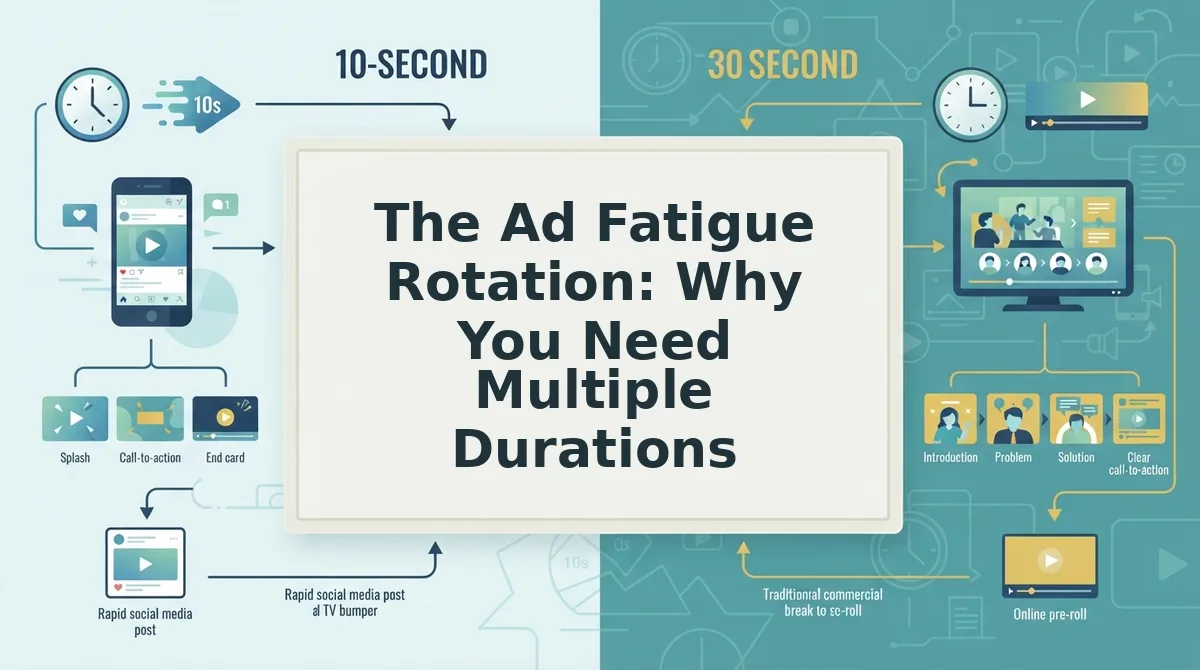
Ad fatigue is the decline in click-through and conversion performance that occurs when the same creative is served repeatedly to the same audience. Duration rotation is one of the most underused defenses against it, because most brands test copy and hooks but keep the same runtime for weeks.
- Week 1-15-second awareness cut. This is the cold-traffic opener that introduces the garment with a fast hook and one clear visual beat. It matters because it establishes the product in the feed without asking for a commitment, and you use it to build a retargeting pool for later weeks.
- Week 2-21-25 second conversion cut. This is the mid-funnel workhorse that shows fit, drape, and fabric detail to viewers who have now seen the shorter version. It matters because the added runtime gives hesitant shoppers the information they need to click through, and you use it against the audience built in Week 1.
- Week 3-10-second retargeting cut. This is the reminder ad for users who engaged but did not purchase. It matters because the viewer already has context, so a short, direct re-exposure with a strong CTA is more effective than re-explaining the product, and you use it to close the loop on abandoned interest.
- Week 4-30-second product launch or hero-piece cut. This is the storytelling reset that re-engages audiences who have seen every shorter variant. It matters because a longer, narrative-driven edit feels like new creative even when the garment is the same, and you use it to refresh the campaign before fatigue fully sets in.
Rotating through these four durations on a weekly cadence keeps the same SKU feeling fresh across a month of paid spend. Next, we look at how to shorten a clothing ad without losing the garment story.
How to Shorten a Clothing Ad Without Losing the Garment Story
A 10-second clothing ad can still tell a complete product story if every shot earns its frame. You need at least three source angles, front, detail, and on-body, before you start cutting.
- Open your video editor and import all six angles. Drag front, back, side, flat lay, fabric detail, and on-body shots onto the timeline in that order. You should see six clips stacked sequentially, each currently at 2-3 seconds.
- Select the first clip and set its duration to 1 second. Use the clip trim handle or the Duration field in the inspector. This becomes the hook: a full-garment front shot that shows silhouette and color immediately. You should see the clip shrink to exactly 1.0s on the timeline ruler.
- Click the second clip (silhouette or back angle) and trim to 2 seconds. This shot establishes shape and drape. You should now have 3 seconds of timeline filled.
- Select the fabric detail clip and set it to 2 seconds. Zoom to 120% if the texture is not visible at full frame. This is where perceived quality lives, stitching, weave, or print clarity. You should see the detail fill the frame without pixelation.
- Trim the on-body fit clip to 2 seconds. If you only have a flat lay, substitute a side profile. The viewer needs to see how the garment sits on a body. You should be at the 7-second mark.
- Set the lifestyle clip to 2 seconds and the final CTA frame to 1 second. The lifestyle shot shows context (street, studio, or mirror setting). The CTA frame can be a text overlay on the front shot or a brand logo card. You should land at exactly 10 seconds.
- Export at 1080×1920, 30fps, and review the sequence once at full speed. The shot order should read: hook (0-1s), silhouette (1-3s), fabric detail (3-5s), fit on body (5-7s), lifestyle (7-9s), CTA (9-10s). If any transition feels rushed, steal half a second from the lifestyle clip before touching the detail or fit shots.
This framework preserves the garment story because it follows the same order a shopper inspects clothing in person: overall look first, then texture, then fit, then context.
FAQ: Clothing Video Ad Length on TikTok
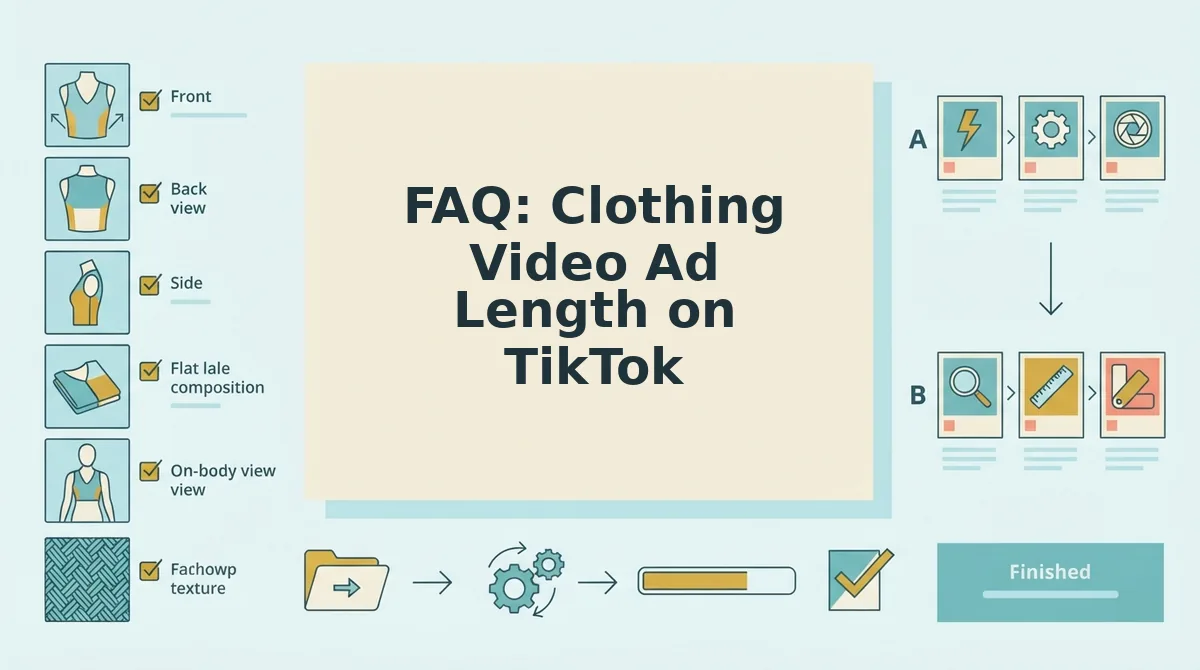
TikTok clothing ads perform best between 15 and 21 seconds, with a 3-second garment reveal at the start. Shorter ads work only for retargeting or single-feature highlights.
What is the best TikTok ad length for clothing brands?
15 to 21 seconds is the sweet spot for clothing brands on TikTok in 2026. This window allows enough time for a garment reveal, one fabric detail, and a fit-on-body shot without losing viewer attention. Ads under 10 seconds typically skip the detail shot that drives perceived quality.
Do 5-second TikTok ads work for fashion?
5-second ads work only for retargeting audiences who have already seen the full product story. A cold audience needs at least 3 seconds just to register the garment silhouette, leaving no time for fabric, fit, or context. Use 5-second cuts as frequency cappers, not as primary prospecting creative.
How long should a TikTok ad be for a new product launch?
A new product launch ad should run 21 to 30 seconds. Unfamiliar garments need extra time to establish what the item is, how it fits, and why it matters. Once the launch audience has seen the full story, you can cut 10- and 15-second versions for retargeting.
Can I use the same video length for TikTok and Instagram Reels?
Yes, 15 to 21 seconds works across both TikTok and Instagram Reels. Both platforms reward completion rate, and both audiences swipe at similar thresholds. The main difference is aspect ratio: TikTok favors 9:16 full-bleed, while Reels crops slightly in-feed, so keep critical garment details centered.
Why does my clothing ad drop off after 3 seconds?
Your hook is not showing the garment clearly enough. Clothing ads lose viewers when the first 3 seconds feature a person's face, a logo, or a setting instead of the product. Open on the full garment silhouette, then cut to detail. Viewers who cannot identify the item immediately swipe.
How many different ad lengths should I run for one clothing product?
Run three durations per product: a 21-second full story for cold audiences, a 10-second mid-length cut for warm audiences, and a 5-second retargeting clip. This rotation delays creative fatigue and lets TikTok's algorithm optimize delivery by audience segment.
The Duration Decision Is a Garment Decision
Every clothing ad length question on TikTok resolves to one trade-off: how much of the garment story can you tell before the swipe. The 3-second garment rule sets the floor. The 15-to-21-second sweet spot sets the ceiling for most cold-audience campaigns. What changes per product is not the formula but which shot earns the extra seconds, a textured knit deserves more detail time than a basic tee, and a structured jacket needs more silhouette time than a draped dress.
The brands winning on TikTok in 2026 are not chasing shorter ads. They are running duration rotations built from the same multi-angle assets, letting the platform optimize while they protect the garment story. If you already own front, detail, and on-body photography, the next step is turning those stills into motion. Upload your multi-angle product photos to the clothing video generator and produce 10-, 15-, and 21-second UGC-style cuts from the same source set. The duration question stops being theoretical once you can test all three against your own cost per acquisition.