

Every day, fashion brands burn thousands of dollars on video ads that viewers scroll past before the garment ever registers on screen, and the culprit is rarely the creative itself. It's the duration. If your hook lands at second four but your ad dies at second three, you've paid for an impression that never had a chance. Fashion video ad duration mistakes are the quiet budget killer most performance teams never audit.
You're not alone if you've watched a 30-second cut underperform a 9-second loop and couldn't explain why. This article will show you exactly how to match duration to platform, funnel stage, and garment complexity, then apply a repeatable framework so every second earns its keep. You'll learn the platform-by-platform decision matrix, the 3-6-15 structure that fits apparel buying psychology, and the one duration mistake that silently inflates CPC on Meta.
Before you touch another export, check how your current cuts line up against clothing video duration by ad placement, the mismatch might already be costing you. And if you're generating UGC-style motion from static product photos, the platform lets you render multiple duration variants from the same source images, so you can test short and long cuts without a reshoot. One finding later in this article will likely change how you brief your next prospecting campaign.
How Long Should a Fashion Video Ad Actually Be?
Fashion video ad duration is the total runtime of a paid social or pre-roll video creative, and the correct length depends on three variables: the platform you're buying on, the funnel stage of the viewer, and how visually complex the garment is. There is no single "best" duration, but there is a predictable range per context.
Think of ad duration like a storefront window. A prospecting ad is a passerby glancing through glass: you have seconds to make them stop. A retargeting ad is a shopper already inside the store: you can afford a longer conversation about fabric, fit, and detail. The same garment needs a different window treatment depending on who's walking by and where.
Start with the platform. TikTok, Instagram Reels, and YouTube Shorts reward 6-10 second cuts for cold audiences because the feed is swipe-native and attention is scarce. Meta feed retargeting can stretch to 15-30 seconds because the viewer has already expressed intent. Stories placements sit in the 6-10 second range regardless of funnel stage. YouTube pre-roll, where a skippable ad must earn five seconds before the "Skip" button unlocks, performs best at 15-30 seconds for viewers who choose to stay.
Then layer in the framework: a 3-second hook that shows the garment on a body or in motion immediately, a 6-second proof that lands the key visual detail (fit, drape, texture, or color accuracy), and a 15-second story that carries retargeting viewers through context, styling, and a call to action. Prospecting ads compress this to hook-plus-proof. Retargeting ads earn the full arc.
For a deeper breakdown of the shortest, most unforgiving placement, see how long clothing video ads should be on TikTok. The platform's algorithm favors completion rate, which means a 6-second ad watched fully outperforms a 15-second ad abandoned at second four, even if both carry the same creative.
How to Match Ad Duration to Platform and Funnel Stage
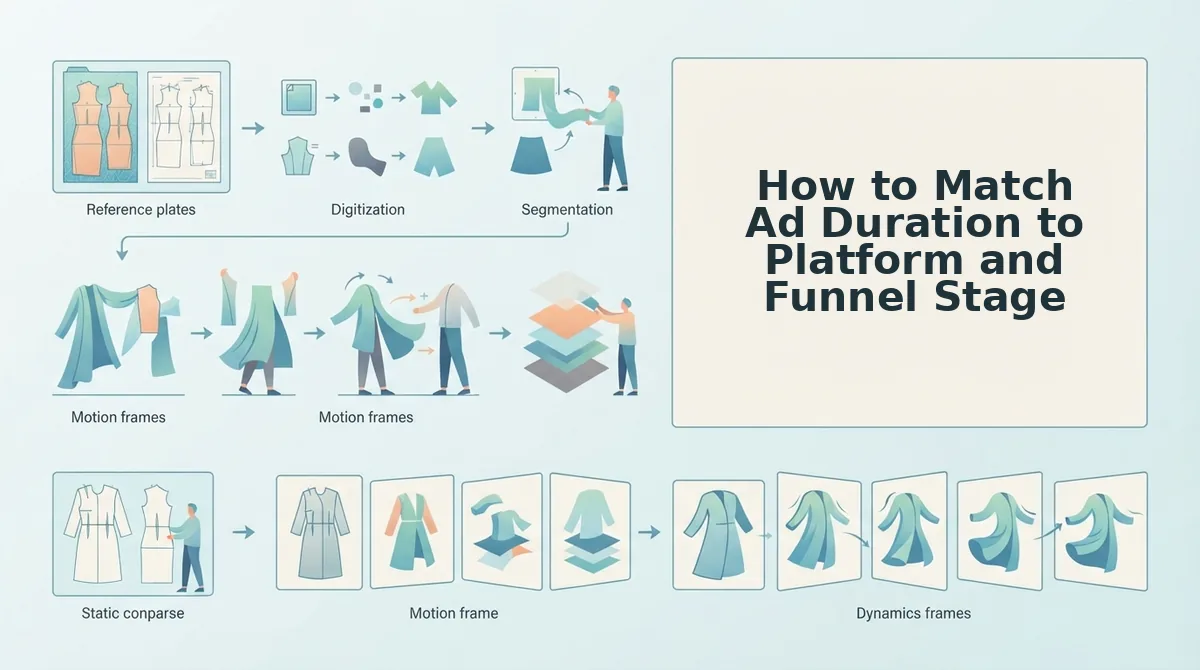
Matching duration to context is a four-step workflow that takes about 15 minutes per campaign. You'll need your media plan, the funnel stage for each audience segment, and your source product imagery or video variants.
- Identify the platform and placement. Open your ads manager and list every placement where the creative will run. TikTok, Reels, Shorts, and Stories are swipe-native: assign them to the 6-10 second bucket. Meta feed retargeting and YouTube pre-roll go to the 15-30 second bucket. You should see a clean split between short-form and extended placements before moving on.
- Determine the funnel stage for each audience. Label each ad set as prospecting (cold) or retargeting (warm). Prospecting audiences need the shortest cut that still shows the garment clearly, typically 6-10 seconds. Retargeting audiences can carry 15-30 seconds because they've already seen the product and need detail reinforcement, not introduction.
- Assess garment visual complexity. A solid-color tee reads in under three seconds; a draped dress with texture, movement, and multiple angles needs more time to communicate value. For complex garments, extend within the platform's range, a 10-second Reels cut instead of 6, or a 30-second retargeting cut instead of 15. Simple garments can sit at the floor of the range.
- Apply the 3-6-15 framework and export variants. Build a 3-second hook that opens on the garment in motion, a 6-second proof cut for prospecting, and a 15-second story cut for retargeting. If you're working from static product photography, generate multiple duration variants from the same source images so every placement gets a native-length file. You should end with a duration matrix mapped to every ad set in your plan.
For placement-specific guidance, review TikTok fashion video ads and Instagram Reels fashion video ads before locking durations. Prospecting ads run shorter because apparel purchase decisions are visual recognition first and detail evaluation second, cold viewers need to recognize the garment, not study it.
Once your durations are mapped, the next question is whether short or long cuts actually move your CPC, and the answer is less obvious than most media buyers assume.
Short vs Long Fashion Video Ads: What Actually Lowers CPC?
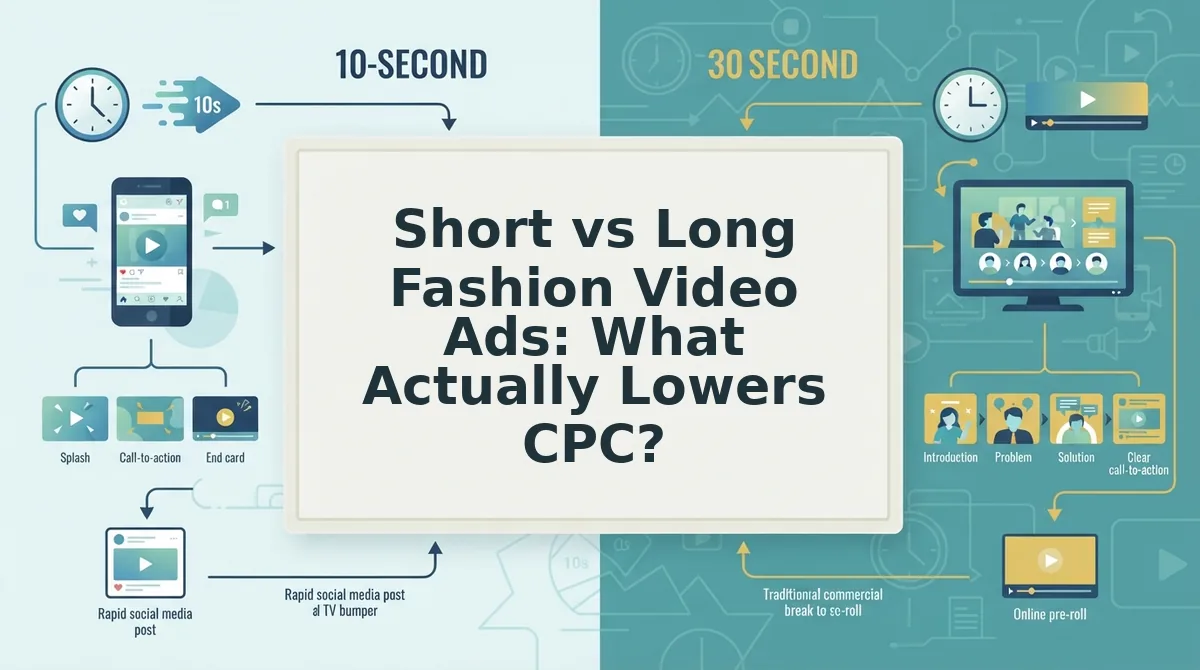
Neither short nor long fashion video ads inherently lower CPC, what lowers CPC is matching duration to the amount of visual information your apparel item needs to communicate. A 6-second clip of a plain t-shirt can drive cheap clicks, but the same length applied to a draped dress with fabric movement and fit details often produces high CTR with weak conversion, forcing higher spend to hit revenue targets.
The "6-second rule" that dominates performance marketing advice was built for impulse categories with instant visual comprehension. Apparel is different: fabric weight, drape, fit across body types, and movement require visual time that a 6-second cut simply cannot deliver. When a fashion ad is too short, viewers click out of curiosity rather than purchase intent, and the platform optimizes toward more of those low-quality clicks.
Creative fatigue is the hidden CPC driver most duration discussions miss. Ultra-short ads fatigue faster at high frequency because there is less visual information to process, viewers tune out after the third exposure. Longer ads fatigue slower but cost more per impression, meaning you need stronger retention to justify the spend.
| Duration | CPC Behavior | Retention Profile | Fatigue Rate | Best For |
|---|---|---|---|---|
| 6-10 seconds | Lowest CPC, highest click volume | Sharp drop-off after 3 seconds | Fast, fatigues in 3-5 days at scale | DTC brands running broad prospecting on simple items (tees, basics, accessories) where the product is instantly understood |
| 15-20 seconds | Moderate CPC, higher purchase intent per click | Retention holds through hook + one product detail beat | Moderate, fatigues in 1-2 weeks | Shopify fashion stores showcasing fit, fabric texture, or a single styling angle on mid-complexity apparel |
| 30-45 seconds | Highest CPC, lowest volume, strongest conversion per click | Retention requires narrative or multi-angle progression | Slow, can run 3-4 weeks before fatigue | Performance creative teams retargeting warm audiences with full garment storytelling (drape, movement, detail shots) |
Short-form video ads do have a legitimate advantage: they are cheaper to produce at SKU scale, and platforms reward them with lower CPMs in feed environments. A brand running 200 SKUs cannot afford 30-second bespoke edits for every product. This is where an AI clothing ad generator changes the economics, it produces multiple duration variants from the same source photos without additional shoot costs, so you can test 6-second hooks against 20-second fit-focused cuts without multiplying production spend.
Here is the contrarian take the data supports: for apparel specifically, the 6-second rule is killing brands that apply it blindly. A 6-second fashion ad shows a garment but cannot show how it moves, how it fits a real body, or why the fabric justifies the price. Those clicks arrive cheap and leave without converting. The metric that matters is not CPC in isolation, it is CPC divided by conversion rate, which is cost per acquisition.
Best for impulse-driven DTC brands with simple products: Short 6-10 second ads. If your catalog is basics, accessories, or single-color items where the photo already tells the full story, short ads maximize reach per dollar and CPC stays low because intent is immediate.
Best for premium apparel, fit-sensitive categories, and retargeting: Long 15-45 second ads. When fabric, drape, sizing, or styling context drives the purchase decision, longer ads give viewers the visual evidence they need to click with intent, and intent-driven clicks convert, which is what actually lowers your effective CPC.
7 Fashion Video Ad Duration Mistakes That Waste Ad Spend
Most fashion ad spend is wasted not on bad creative but on creative shown for the wrong amount of time. These seven duration mistakes are the most common and most expensive across apparel accounts.
- Applying the 6-second rule to every apparel item. Ultra-short ads work for impulse categories where the product is understood in one glance, but apparel needs visual time for fabric, fit, and drape to register. A 6-second dress ad shows the garment exists but not why it is worth the price, producing cheap clicks that rarely convert.
- Running one duration across every platform. TikTok rewards 9-15 second native-feeling clips, Instagram Reels tolerates 15-30 seconds for fashion content, and YouTube Shorts viewers will watch up to 45 seconds if the hook holds. Uploading the same 6-second cut everywhere leaves retention on the table on platforms where viewers expect more.
- Matching duration to production cost instead of decision complexity. Brands often cut ads short because longer edits cost more to produce, not because the product needs less time. A draped silk dress with fit complexity needs 20+ seconds regardless of budget, cutting it to 10 seconds to save production cost just shifts the cost to wasted ad spend.
- Letting the hook eat the entire ad. A strong 3-second hook is essential, but when the hook consumes half of a 6-second ad, there is no time left for the product to do its job. The hook should earn attention; the remaining seconds must deliver the visual proof that drives purchase intent.
- Ignoring drop-off data when choosing length. Retention curves tell you exactly where viewers leave. If 70% of viewers drop before the 6-second mark, your hook is the problem, not your total duration. If retention holds through 15 seconds but collapses at 20, cut to 15. Read the curve at 6s, 15s, and 30s before changing total length, the data already contains the answer.
- Treating duration as fixed instead of a testing variable. Duration is one of the cheapest variables to test because the same source footage can be recut at multiple lengths without new shoots. Brands that lock one duration and never revisit it leave a measurable CPC and conversion improvement untested.
- Not testing duration as a variable with a structured sequence. The fix is a three-test sequence: first test hook length (3s vs 5s vs 7s) at a fixed total duration, then test total duration (10s vs 20s vs 30s) with the winning hook, then test platform-specific cuts of the winning duration. Tools that generate dynamic 10-second clothing clips from existing product photos make this sequence practical at SKU scale without additional shoot days.
Fashion Video Ad Duration FAQs
Direct answers to the duration questions fashion brands ask most often, based on how the platform data and apparel advertising patterns actually behave.
How long should a clothing ad be?
A clothing ad should be 15-20 seconds for most apparel items, with 6-10 seconds reserved for simple products like basics and accessories, and 30-45 seconds for premium or fit-sensitive garments in retargeting. The right length is determined by how much visual time your product needs to communicate fabric, fit, and drape, not by a universal rule.
Does longer video mean lower CPC?
No, longer video typically means higher CPC because platforms charge more for sustained attention and longer ads get fewer impressions per dollar. However, longer fashion ads often produce lower cost per acquisition because the clicks they generate carry higher purchase intent, especially for apparel where viewers need to see fit and fabric before buying.
What duration works for SKU-level product videos vs brand storytelling?
SKU-level product videos perform best at 10-20 seconds because the goal is showing one garment clearly from two or three angles. Brand storytelling ads can run 30-60 seconds because they are building narrative and emotional connection rather than driving immediate product comprehension. Mixing these two purposes at the wrong duration wastes spend on both.
6 second vs 15 second fashion ad, which converts better?
A 15-second fashion ad converts better than a 6-second ad for most apparel because it provides enough time to show the garment in motion, demonstrate fit, and reveal fabric texture, the three visual proofs that drive clothing purchase decisions. A 6-second ad can win on CPC and click volume, but the 15-second version typically wins on cost per acquisition for anything beyond basic items.
Why do my fashion ads get clicks but no sales?
Clicks without sales on fashion ads usually mean the ad is too short to communicate what the product actually is, so viewers click out of curiosity rather than purchase intent. When a garment's fit, fabric, or drape is not shown before the click, the landing page has to do all the persuasion work, and it rarely can. Extending the ad to show the product in motion from multiple angles, which you can generate from existing product photo to video assets, typically improves click quality and conversion rate.
Fix the Duration Problem at the Source
Every mistake in this article traces back to one root cause: you're locked into a single cut. The 15-second edit that underperforms on TikTok can't become a 6-second hook without a reshoot. The 30-second product story that flops in-feed can't compress into a 9-second retargeting punch. That rigidity is what actually wastes ad spend, not the duration itself.
The fix is structural. Generate SKU-level motion from product photos you already own, then render the same creative at multiple lengths. A fashion UGC generator turns one set of packshots into 6-, 9-, 15-, and 30-second variants without a single reshoot. Test them against each other. Let the platform data decide.
Rob Prsa's breakdown of AI-generated fashion ad workflows confirms the pattern: creators who test multiple variations systematically outperform those who iterate manually. The bottleneck isn't creative quality, it's creative throughput.
Your next step: upload one product's existing photos, generate three duration variants, and run them in the same ad set. The winning length will tell you more about your audience than any benchmark chart.
Duration is a targeting variable, not a creative constraint, test it like one.